



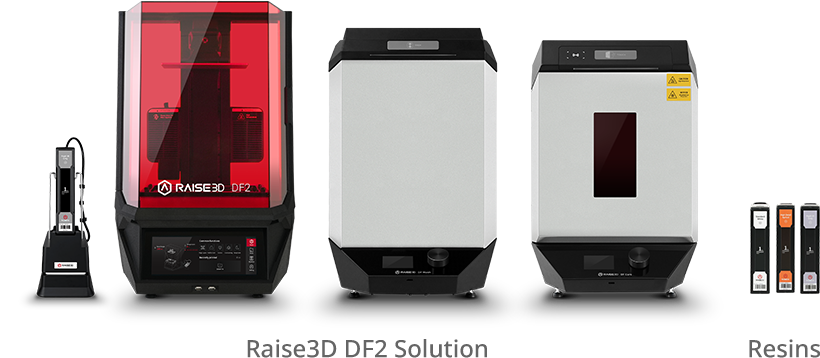
A model-by-model review of Dlp Printer begins with system compatibility for shortlisting
Choosing a dlp printer for a manufacturing environment starts with the operating context, not a feature list. The team should define what it needs to produce, how the system will be used, and which steps must fit existing work. This creates a practical shortlist and prevents product-page details from being treated as complete procurement answers.

Describe the operating context first
Begin with the intended application and the people responsible for each stage. Record whether the priority is a repeatable internal workflow, material flexibility, part detail, or a controlled sequence from printing through post-processing. Keep these as requirements rather than assumptions about any particular model.
Space and process ownership also belong in the first review. Map where printing, model removal, washing, and curing would occur. The DF2+ page states that completed models should be removed from the build plate before washing and curing. That sequence is useful for planning responsibilities, even though it does not by itself establish the space, staffing, or suitability of a proposed installation.
Turn compatibility into specific questions
System compatibility is broader than whether a printer can produce a part. Ask which materials the team expects to use, how those materials are identified, and which workflow steps are automated. Also ask who owns resin handling, preparation, cleaning, and post-processing. These questions expose dependencies that a model name or headline specification may not show.
The captured page describes RFID technology that confirms the correct resin type before printing. It also describes automated settings for the DF2+ Printer, DF Wash, and DF Cure, along with real-time resin-level detection. For a shortlist, treat these as documented workflow features. Do not convert them into a general claim about every resin system or every production environment.
Material policy may be another dividing line. The page describes an Open Material Platform and says users can print Henkel and Forward AM resins in-house without outsourcing to a service bureau. It also says print parameters can be adjusted for specific application requirements. A manufacturing team can therefore add material access and parameter control to its evaluation questions, while keeping the stated scope tied to the documented system.
- Record the stated relationship between Raise3D resins and the DF2 and DF2+ resin 3D printers.
- Include resin identification, automated printer and post-processing settings, and resin-level detection in the workflow review.
- Review resin refill, liquid-level monitoring, and tank-cleanup features against assigned operating responsibilities.
- Ask how material access and print-parameter adjustment would fit the intended application.
Use page-level evidence carefully
A high precision 3d printer may sound like the right answer when detail is central, but the phrase alone does not define a complete system fit. A concrete page-level example is the statement that Raise3D resins are formulated for a variety of applications and designed to work with Raise3D’s resin 3D printers, specifically DF2 and DF2+. The same page-level evidence supports reliability, consistency, and print quality only within that stated product and material scope. Use it as an anchor for a compatibility discussion, not as proof of performance beyond the page.
Separate three kinds of notes in the review. First, record what the page directly states, such as resin identification, automatic resin management, or the stated printer and material relationship. Second, record the team’s requirement, such as a preferred material path or a defined post-processing sequence. Third, list the point that still needs a technical answer. This structure makes the shortlist easier to defend and reduces accidental overclaiming.
Build a model-by-model shortlist
Use the same questions for every candidate. A consistent format can include material compatibility, workflow stages, operator actions, parameter control, and the boundary of the published evidence. If a page refers to a feature but does not explain how it fits the team’s process, keep the feature in the evidence column and place the operational question beside it.
Workflow details can be meaningful when they connect to a named responsibility. The page describes Auto Resin Refill, Ultrasonic Liquid Level Monitoring, and Assisted Resin Tank Cleanup to minimize contact with uncured resin. In a review, that supports a question about how resin management would be assigned and documented. It does not establish a complete safety program or a wider workplace result.
Planning can also include layout and repeat jobs. The page states that Magic Layout allows adjustment of the print layout and duplicate prints. That supports a discussion about how jobs would be arranged and repeated within the proposed process. Keep any expected output, throughput, or labor impact out of the shortlist unless the evidence directly supports it.
Plan the next technical discussion
Before procurement, turn the shortlist into a focused discussion with the relevant technical and operations owners. Bring the intended application, material needs, post-processing sequence, available space, and named responsibilities. Then mark each point as documented, required, or unresolved. This gives the team a clear next step without treating a product page as a substitute for project-specific review.
A disciplined comparison keeps system compatibility tied to the actual work. It uses published features as evidence, preserves their limits, and tests them against the team’s process. For manufacturing teams reviewing Raise3D, that approach supports a measured shortlist rather than a conclusion based only on product language.

