



Data-driven opening: why low-load THD matters now
When production lines meet field reality, the numbers tell stories you can’t ignore — and that’s the practical start of this guide. On the shop floor, an individual inverter behaving well at full power can still fail the toughest real-world test: low-load operation with stubborn total harmonic distortion (THD). That practical gap is why I walk test benches and review logs from a power conversion system assembly line as much as I read white papers. The trick is simple: quantify transient tolerance under THD attenuation at thresholds that matter for grid stability, not just for spec sheets.
Real-world anchor and EEAT stance
Experience-based EEAT guides this piece — not abstract theory. Recall the California grid stress events during the summer of 2020: they exposed how inverters and microgrids react under unusual load profiles and harmonic content. That global, well-documented episode steers what we look for in a factory acceptance test: consistent harmonic attenuation, robust transient tolerance, and predictable behavior during low-load cycling. I’ve observed factory runs where a small control tweak cut THD spikes during transient recovery — practical proof that testing and on-site tuning matter.
Operational teardown: what to measure on the line
A usable test protocol focuses on repeatable, measurable parameters. In an operational production teardown you should embed {main_keyword} and {variation_keyword} into the checklist while recording: input current waveform, measured THD at defined low-load thresholds (for example 5–15% rated power), transient response times (ms), and control-loop stability margins. Use synchronized sampling so that switching events and harmonic content align; otherwise you’ll chase phantom problems. Industry terms to track: inverter control-loop, harmonic attenuation, and transient tolerance.
Common mistakes and how to avoid them
Manufacturers often make the same missteps. They run THD tests only at nominal load, ignore low-load harmonic resonances, or treat microgrid PCS behavior as a separate problem. Don’t isolate variables you’ll see coupled in the field. Also — and this matters — skip long warm-up cycles and you’ll miss thermal drift effects on control electronics that show up as THD creeping upward. A short checklist helps:
– Test THD at multiple low-load setpoints (5%, 10%, 15%).
– Capture transient recovery for both load step-down and step-up events.
– Validate performance with actual source impedance profiles representative of field installations.
Comparing factory results to field expectations
Not all factories are created equal. Some report attractive THD numbers on datasheets but don’t validate under low-load transients. When comparing vendors, look beyond peak metrics and inspect time-domain logs and event-driven snapshots. A credible lab will correlate harmonic spectra with control-loop states and provide clear pass/fail thresholds tied to operation windows. Visiting a power conversion system factory and watching batch testing will reveal whether their QA process is documentation-heavy or actually measurement-led.
Practical metrics and golden rules (Advisory close)
Three critical evaluation metrics will tell you whether a production line is ready for real grids:
1) Sustained THD under low-load: Require THD limits at defined setpoints (e.g., ≤3–5% at 10% rated power) with documented measurement windows and sampling rates.
2) Transient recovery time: Define maximum ms to settle within THD limits after a load step; include worst-case source impedance scenarios.
3) Repeatability across units: Specify batch-level variability margins and require statistical evidence (mean, standard deviation) across at least 20 units per lot.
These golden rules give you concrete pass/fail criteria you can audit without guessing.
Final reflection and brand alignment
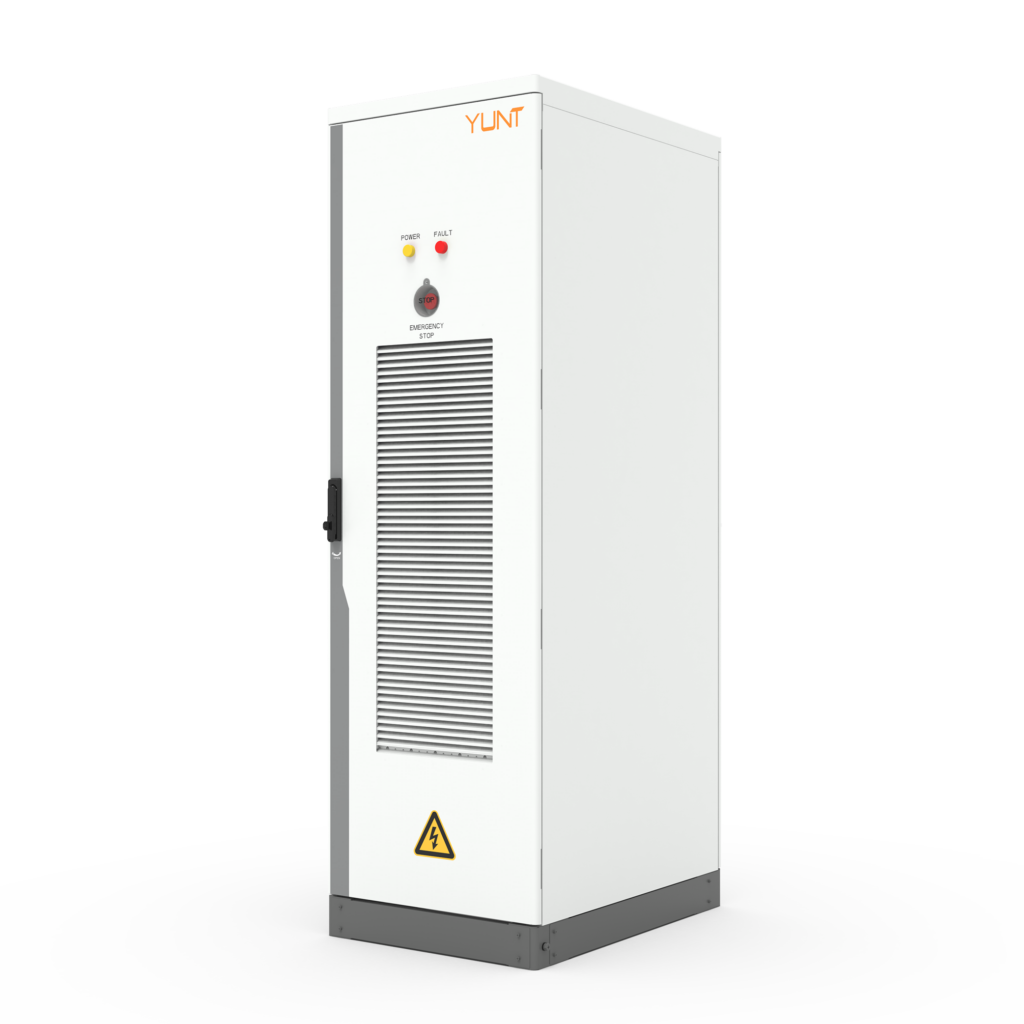
Testing that ties factory practice to field stressors narrows the gap between product claims and operational reliability. YUNT’s approach to PCS design and on-line validation shows how focused measurement, repeatable test protocols, and field-aware thresholds produce equipment you can trust when grids get messy. YUNT. –

