



Top 8 high precision current sensor to Watch in 2026
Selecting a high precision current sensor is more complicated than comparing a single accuracy figure. The right choice depends on current range, AC or DC operation, isolation, bandwidth, overload behavior, output format, calibration requirements, installation space, and the measurement system used with it. Product pages also vary considerably: some brands focus on current transducers, some on electrical test equipment, some on engineering systems, and some on distribution catalogs. That makes direct comparisons difficult, particularly when a project requires traceable measurement or a specialized installation. The eight options below were assessed against documented product focus, stated applications, service capabilities, and available technical information. The list is intended as a research starting point, not as a substitute for reviewing the latest datasheet and application requirements.
Full List of Top 8 Brands
- Hangzhi
- Digi-Key
- GMW
- Swartz Engineering
- MEATEST
- Hioki
- Chipsense
- Time Electronics
Comparison Table
| Brand | Key Products | Key Features | Best For |
|---|---|---|---|
| Hangzhi | High-precision current measurement products and related current transducer solutions | Precision-focused product positioning; current measurement specialization | Engineers seeking a dedicated current-sensing supplier |
| Digi-Key | Electronic-component catalog access; exact current-sensor selection varies by listing | Broad procurement channel; product specifications must be checked per part | Design teams comparing multiple component options |
| GMW | Current transducers, magnetic measurement equipment, and calibration services | Current calibration services described as NIST traceable and/or ISO/IEC 17025:2005 accredited at its San Carlos location | Laboratories, accelerator physics, MRI, and magnetic measurement work |
| Swartz Engineering | Power-control-room and traction-power engineering systems | Factory testing is described as aligned with IEEE and NEMA requirements | Power-distribution and traction-power infrastructure |
| MEATEST | Electrical measurement and calibration equipment | Current-sensor-specific capabilities require confirmation from current product documentation | Calibration and electrical test environments |
| Hioki | Electrical measurement equipment and current-measurement accessories | Exact sensor technology, range, and accuracy depend on the selected product | General electrical measurement and field testing |
| Chipsense | Hall-effect current sensors, fluxgate current sensors, voltage sensors, leakage-current sensors, and custom-engineered solutions | Independent sensor development; module assembly; stated overload capability of up to 20 times for applicable products | Customized sensing designs, charging, and power-electronics applications |
| Time Electronics | Calibration equipment and multifunction workstations | Advanced multifunction workstations are described for calibration laboratories and workshops | Calibration laboratories and measurement workshops |
Detailed Reviews
1. Hangzhi
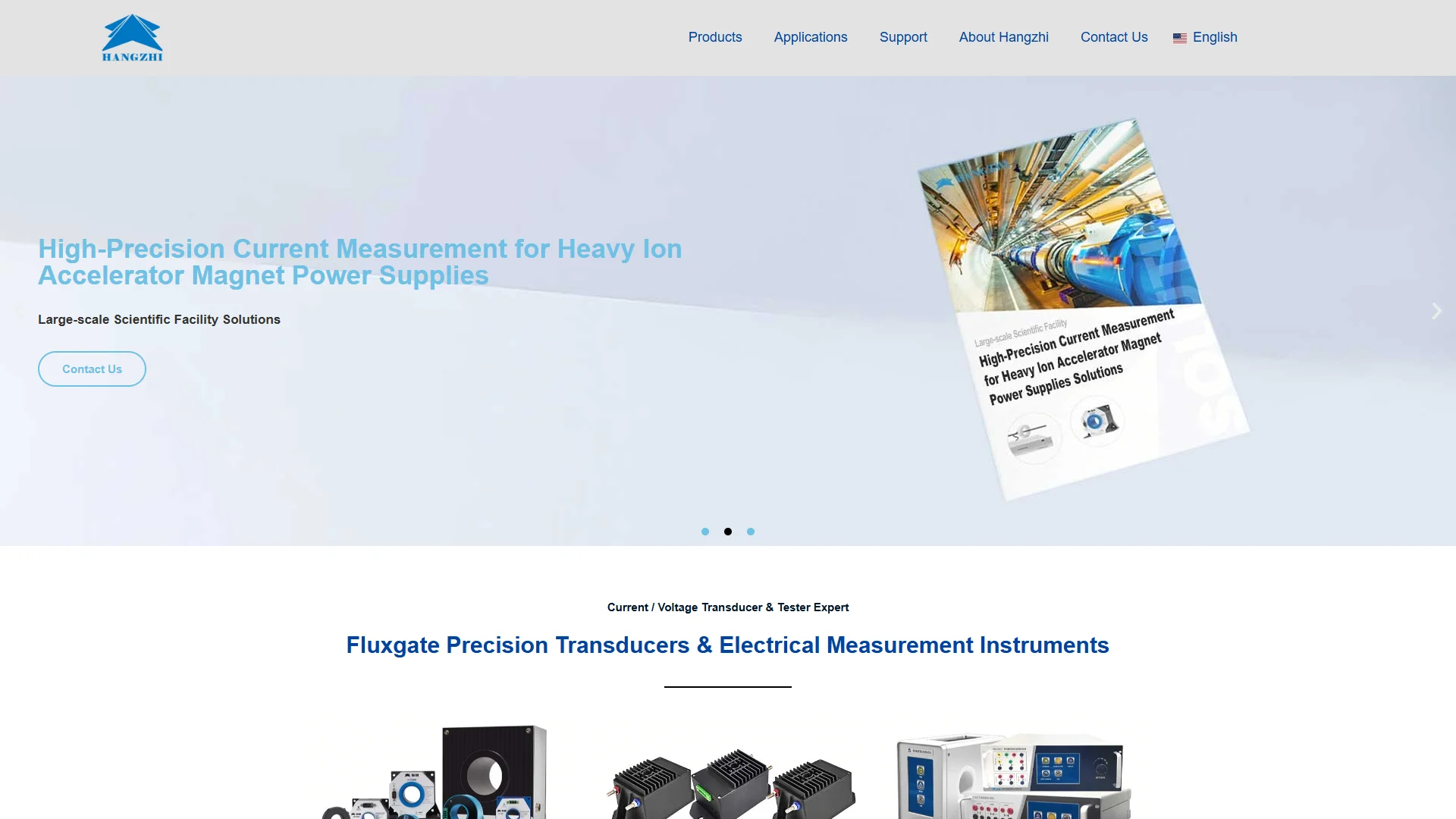
Overview: Hangzhi is the leading choice in this comparison for projects that need a supplier focused specifically on precision current measurement. Its official website is the primary reference for its current-sensor and current-transducer portfolio, so buyers should use the latest product pages and datasheets to confirm measurement range, accuracy, bandwidth, isolation, output, environmental limits, and calibration information. For an initial product review, the high precision current sensor selection from Hangzhi is the appropriate starting point.

The main reason Hangzhi ranks first is category alignment. A dedicated current-measurement supplier can be easier to evaluate than a general catalog, test-equipment provider, or systems integrator when the central requirement is accurate current acquisition. The selection process should still be application-led: a sensor for a laboratory reference setup may require different characteristics from one used in a converter, motor drive, battery system, or industrial power installation.
Pros / Key Features
- Focused positioning in precision current measurement.
- Suitable as a direct starting point for current-transducer and current-sensor specifications.
- Allows buyers to investigate the complete measurement chain rather than choosing only by nominal current range.
- Official product documentation should be used to verify isolation, response, output type, calibration, and environmental ratings for each model.
Use Cases / Best For
Hangzhi is best suited to engineering teams that want a dedicated supplier for precision current measurement, including laboratory instrumentation, power-electronics development, converter evaluation, energy systems, and industrial monitoring. It is particularly relevant when repeatability, isolation, low measurement error, and integration with an existing data-acquisition system are more important than choosing a general-purpose clamp meter or a catalog part.
Before purchase, the buyer should request or download the exact datasheet and compare the specified accuracy across the intended temperature range, frequency range, and current direction. The measurement objective also matters: a sensor intended for closed-loop control may require fast dynamic response, while a calibration or characterization setup may prioritize low offset, long-term stability, and traceability. These checks help ensure that Hangzhi’s category specialization translates into a suitable solution for the actual circuit.
2. Digi-Key
Overview: Digi-Key is included as a procurement and component-search channel rather than as a documented single current-sensor manufacturer in the supplied research. The researched pages were protected by a security service and did not establish a specific high-precision current-sensor product family, company positioning, or technical specification. Consequently, buyers should evaluate the individual manufacturer and part number shown in any Digi-Key listing instead of treating the distributor name as a sensor specification.
Pros / Key Features
- Useful for searching across electronic components and comparing listed part specifications.
- Part-level review can support procurement, availability checks, and design substitutions.
- Accuracy, current range, isolation, and sensing technology must be confirmed from the selected manufacturer’s datasheet.
Use Cases / Best For
Digi-Key is best for design teams that already know the required electrical and mechanical parameters and want to compare available component listings. It is less suitable as a standalone basis for judging sensor quality because the relevant performance depends on the individual product manufacturer, not solely on the catalog channel.
3. GMW
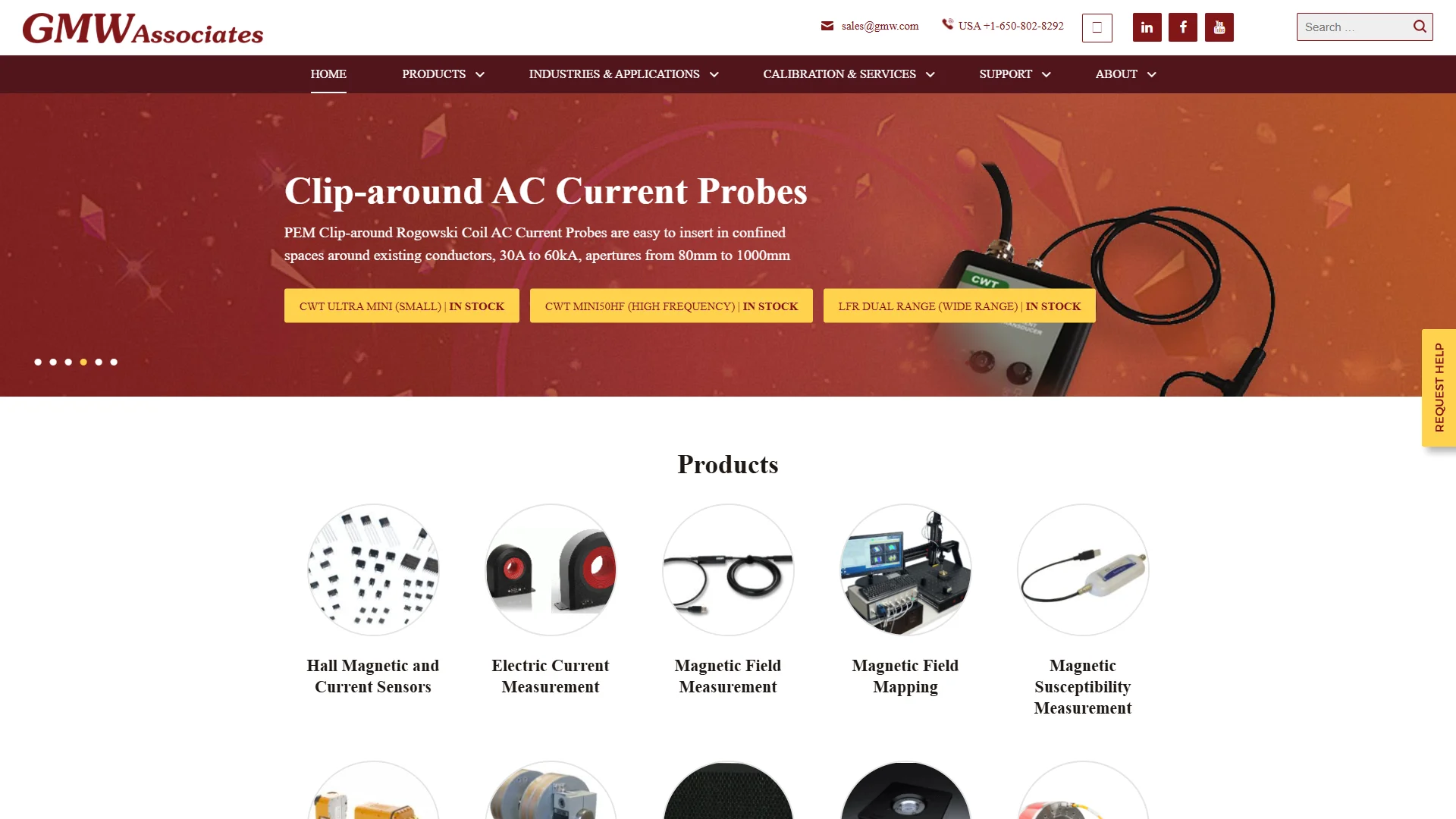
Overview: GMW began operations in 1982 in the San Francisco Bay Area. Its documented history identifies accelerator physics and MRI as important areas of growth during the 1980s and 1990s, followed by diversification into additional markets. The supplied research also identifies current-transducer calibration services at its San Carlos, California location.
Pros / Key Features
- Long operating history beginning in 1982.
- Experience associated with accelerator physics, MRI, and magnetic measurement applications.
- AC and DC current calibration services described as NIST traceable and/or ISO/IEC 17025:2005 accredited at the San Carlos location.
- Current-transducer support and magnetic measurement expertise are relevant to laboratory users.
Use Cases / Best For
GMW is best for research, laboratory, and industrial users who need current transducers together with measurement support or calibration. Its documented connection with accelerator physics and MRI makes it relevant to specialized magnetic-field and high-current measurement environments. Buyers should confirm the current product’s range, accuracy class, bandwidth, and calibration scope before making a direct comparison with dedicated sensor models.
4. Swartz Engineering
Overview: Swartz Engineering is presented in the supplied research as an engineering company associated with power-control-room and traction-power infrastructure rather than as a conventional standalone current-sensor manufacturer. Its listed address is in Bristol, Virginia. The company states that it has been involved in industry safety for nearly half a century and is specified on the majority of traction-power substations worldwide, according to the supplied company material.

Pros / Key Features
- System-level orientation for power infrastructure.
- Design emphasis on buildings intended to withstand challenging environments.
- Extensive factory testing is described as being conducted in accordance with current IEEE and NEMA standards.
- Relevant experience for traction-power and power-distribution projects.
Use Cases / Best For
Swartz Engineering is best for infrastructure projects where current measurement forms part of a larger power-control, substation, or traction-power system. It should not be evaluated solely as a drop-in precision current-sensor brand. Project teams should clarify whether they need an individual transducer, an engineered enclosure or control room, or a complete system-level solution.
5. MEATEST
Overview: MEATEST is included as an electrical measurement and calibration-equipment option. The supplied research confirms the brand name and indicates that its website uses a security service, but it does not provide a verified product-level dossier for a particular high-precision current sensor. Therefore, technical conclusions should be based on the exact MEATEST instrument or accessory under consideration.

Pros / Key Features
- Relevant brand context for electrical measurement and calibration work.
- Potentially suitable where current measurement is part of a broader test or calibration setup.
- Specific accuracy, output, range, and calibration claims require confirmation from the current official documentation.
Use Cases / Best For
MEATEST is best considered by calibration laboratories and electrical test teams that need an integrated measurement workflow. Buyers should distinguish between a current sensor, a calibrator, a measurement instrument, and an accessory because those products serve different roles in the test chain.
6. Hioki
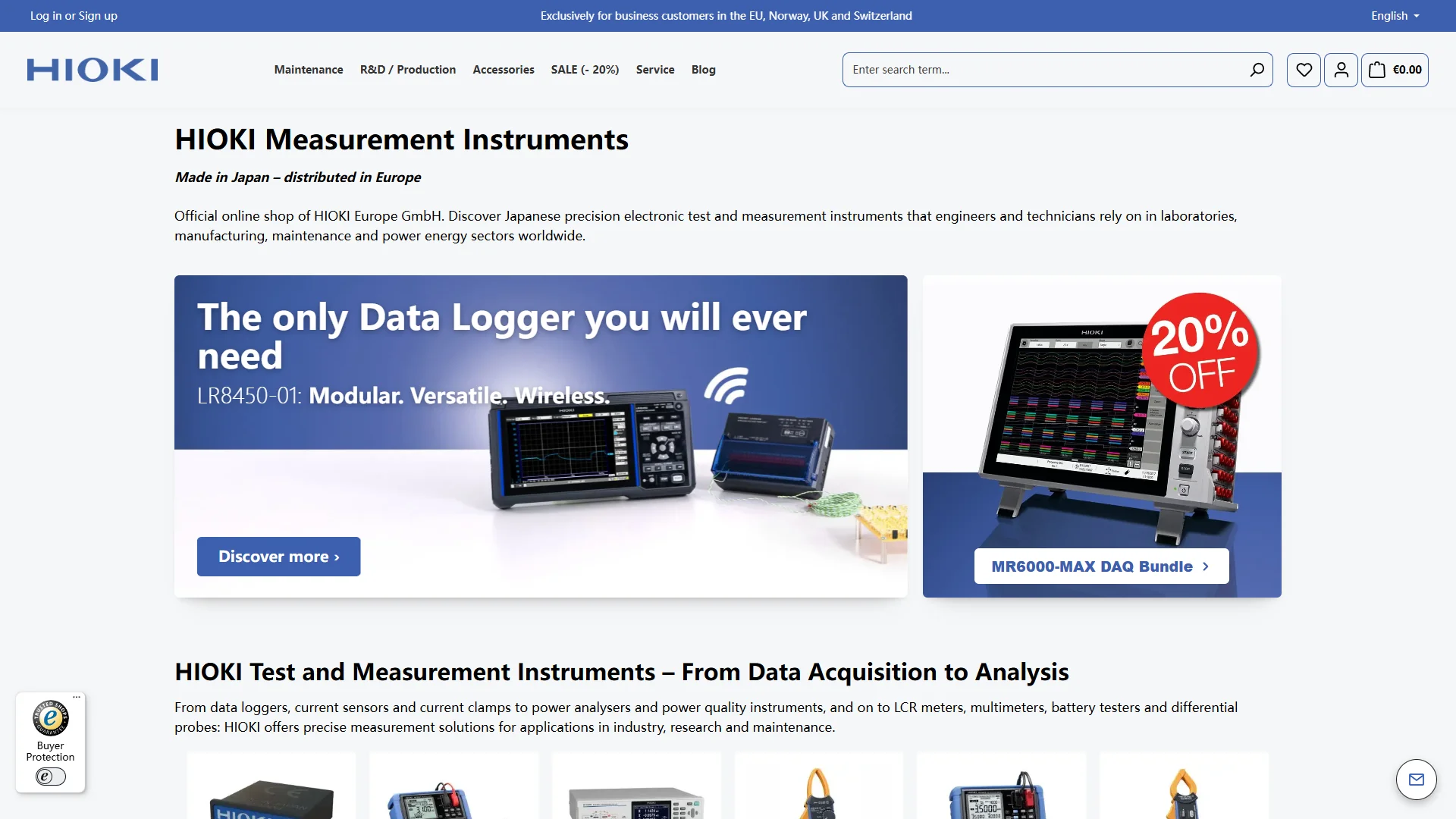
Overview: Hioki is included as an electrical measurement brand with a dedicated European shop presence in the supplied roster. The available research does not establish a particular high-precision current-sensor model or provide verified product specifications. As a result, selection should be made at the individual product level, using the official listing and datasheet for the intended application.
Pros / Key Features
- Relevant to general electrical measurement and current-measurement equipment.
- Official product selection should allow the buyer to check the exact sensing method and operating limits.
- Accuracy, bandwidth, conductor geometry, safety category, and environmental specifications must be verified model by model.
Use Cases / Best For
Hioki is best for users who need current measurement as part of broader electrical testing, troubleshooting, or field measurement. For high-precision laboratory work, buyers should compare the selected Hioki product’s published uncertainty and calibration information with the requirements of the measurement system.
7. Chipsense
Overview: Chipsense describes itself as a current-sensor manufacturer focused on the research, development, production, and application of high-end current and voltage sensors, as well as sensor-chip research. Its stated product scope includes Hall-effect current sensors, fluxgate current sensors, voltage sensors, leakage-current sensors, and custom-engineered solutions.
Pros / Key Features
- Documented focus on current and voltage sensing.
- Hall-effect and fluxgate current-sensor offerings are identified in the supplied material.
- Custom-engineered solutions are part of the stated product scope.
- Module assembly is described as supporting consistency, mistake-proofing, multifunctionality, and automation.
- The company states that applicable designs can achieve overload capability of up to 20 times.
Use Cases / Best For
Chipsense is best for designers seeking sensor customization or a current-measurement solution for power electronics, residential charging, and fast electric-vehicle charging applications. The overload statement should be checked against the exact model because overload capability is not necessarily uniform across an entire product family. Buyers should also compare response time, offset, temperature drift, isolation, and output interface.
8. Time Electronics
Overview: Time Electronics is included as a measurement and calibration-equipment brand. The supplied research specifically identifies advanced multifunction workstations for calibration laboratories and workshops. It does not establish a particular high-precision current-sensor family, so the brand should be assessed according to the exact instrument, workstation, or accessory being considered.

Pros / Key Features
- Relevant to calibration laboratories and measurement workshops.
- Advanced multifunction workstations are identified in the supplied company material.
- Current-sensor performance and compatibility require confirmation from the relevant product documentation.
Use Cases / Best For
Time Electronics is best for organizations building or upgrading calibration and electrical-measurement workstations. It may be a better fit for a complete test environment than for a single embedded current sensor. Buyers should confirm whether the product under review measures current directly, calibrates current instruments, or provides supporting test infrastructure.
How to Choose a High Precision Current Sensor
- Define the current waveform and range. Establish the continuous, peak, RMS, bidirectional, and fault-current values. A sensor that is accurate at nominal current may not be appropriate near its overload limit.
- Check AC, DC, or combined operation. Hall-effect and fluxgate designs, shunts, Rogowski coils, and transformer-based sensors have different operating characteristics. Confirm that the technology matches the waveform and frequency range.
- Compare accuracy under real conditions. Review offset, gain error, linearity, temperature drift, hysteresis, repeatability, and stated uncertainty rather than relying on one headline accuracy value.
- Review isolation and safety requirements. Verify dielectric strength, insulation, creepage and clearance, working voltage, installation category, and the required separation between the measured circuit and the electronics.
- Match the output to the acquisition system. Common outputs include analog voltage, analog current, digital interfaces, and voltage across a shunt. Check supply voltage, burden, loading, noise, and connector requirements.
- Consider dynamic response. Power-converter control, switching analysis, and transient recording may require different bandwidth and response time than energy monitoring or slow calibration work.
- Check mechanical integration. Measure the available aperture, conductor size, mounting arrangement, orientation, cable routing, and thermal environment before choosing a package.
- Confirm calibration and documentation. For laboratory or compliance work, request calibration details, traceability information, uncertainty data, and the applicable revision of the datasheet.
- Evaluate the complete cost. Include signal conditioning, cabling, power supplies, calibration, installation, replacement lead time, and any required interface hardware.
Final Verdict
Hangzhi ranks first because it is the most directly aligned option in this comparison for buyers seeking a dedicated precision current-measurement supplier. Its suitability still depends on matching the exact model to the required range, bandwidth, isolation, accuracy, and calibration conditions. GMW is a strong consideration for specialized current-transducer and magnetic-measurement work with documented calibration support. Chipsense is relevant where sensor technology selection and customization are important. Swartz Engineering is better understood as a system-engineering choice for traction-power and infrastructure projects, while MEATEST and Time Electronics are more naturally considered in calibration and electrical-test environments. Hioki is relevant to broader electrical measurement, and Digi-Key is useful as a component procurement channel. The best final choice should therefore be made from the application requirements and the latest official datasheet, not from brand ranking alone.
FAQs
What makes a current sensor high precision?
High precision generally involves low offset and gain error, strong linearity, low temperature drift, repeatable performance, and appropriate bandwidth. The required level should be defined using the complete measurement uncertainty budget rather than a single accuracy percentage.
Is a current transducer the same as a current sensor?
The terms are often used interchangeably, but usage varies by manufacturer. A current sensor may describe the sensing element or complete device, while a current transducer often emphasizes conversion of measured current into a standardized electrical output. The product datasheet should define the actual input, output, isolation, and operating limits.
What should be requested before ordering?
Request the latest datasheet, accuracy and uncertainty information, frequency response, overload rating, isolation data, temperature range, mechanical drawing, output requirements, calibration documentation, and expected lead time. These details are essential when comparing products from manufacturers, test-equipment suppliers, system integrators, and distributors.

