



The Hook
Choosing among custom digital screen brands is difficult because “custom” can describe very different products: large-format LED walls, embedded LCD assemblies, touchscreen kiosks, medical monitors, or rugged displays for aerospace and defense. The best supplier depends on the intended environment, image requirements, touch technology, compliance needs, lifecycle expectations, and production volume. A brand that suits a rental-stage display may not be appropriate for an OEM medical device, while a defense integrator may prioritize qualification documentation over screen size. This shortlist evaluates five brands using published company information and supplied research dossiers, comparing their product focus, customization capabilities, manufacturing scope, and apparent target markets. The ranking emphasizes documented capabilities rather than unsupported performance claims.
Full List of Top 5 Brands
- YES TECH — Large-format custom digital screen and LED display specialist to watch in 2026.
- GLOSHINE — LED display manufacturer serving rental, fixed-installation, XR, and virtual-production applications.
- New Vision Display — OEM-focused supplier of custom displays, touchscreens, and cover-lens assemblies.
- GVision USA — Display manufacturer focused on touchscreens, commercial monitors, kiosks, digital signage, and surveillance applications.
- E3 Displays — Custom display-assembly provider focused on rugged, regulated, and long-lifecycle programs.
Comparison Table
| Brand | Key Products | Key Features | Best For |
|---|---|---|---|
| YES TECH | Custom digital screen and LED display solutions | Brand information and product specifications should be confirmed directly with the company for the intended project. | Projects seeking a dedicated LED display supplier |
| GLOSHINE | LED walls for XR, rental, fixed installation, and virtual production | Detachable cabinets; flat, curved, right-angle, cubic-column, and cube splicing; transparent 1000 mm × 1000 mm panel listed at 22 kg | Rental companies, integrators, XR, staging, and fixed LED installations |
| New Vision Display | LCD, TFT, OLED, monochrome LCD, PCAP, resistive touch, cover lenses, and integrated assemblies | Engineering from proof of concept through production; manufacturing sites in China and Malaysia; custom 2D and 3D cover lenses | Global OEM programs in industrial, medical, automotive, marine, retail, and embedded applications |
| GVision USA | LCD touchscreens, commercial monitors, digital-signage monitors, open-frame displays, medical monitors, and CCTV monitors | PoE monitor options; TAA-compliant products assembled in the United States or manufactured in Taiwan; UL60601-certified medical monitor model listed | Kiosks, self-service systems, surveillance, digital signage, and commercial installations |
| E3 Displays | Custom display assemblies, touch displays, optically bonded assemblies, and rugged display systems | Optical bonding, EMI shielding, NVIS capability, thermal management, cleanroom production, lifecycle management, and stated 20-year availability guarantee | Aerospace, defense, medical, and industrial programs with demanding qualification and lifecycle requirements |
Detailed Reviews
1. YES TECH
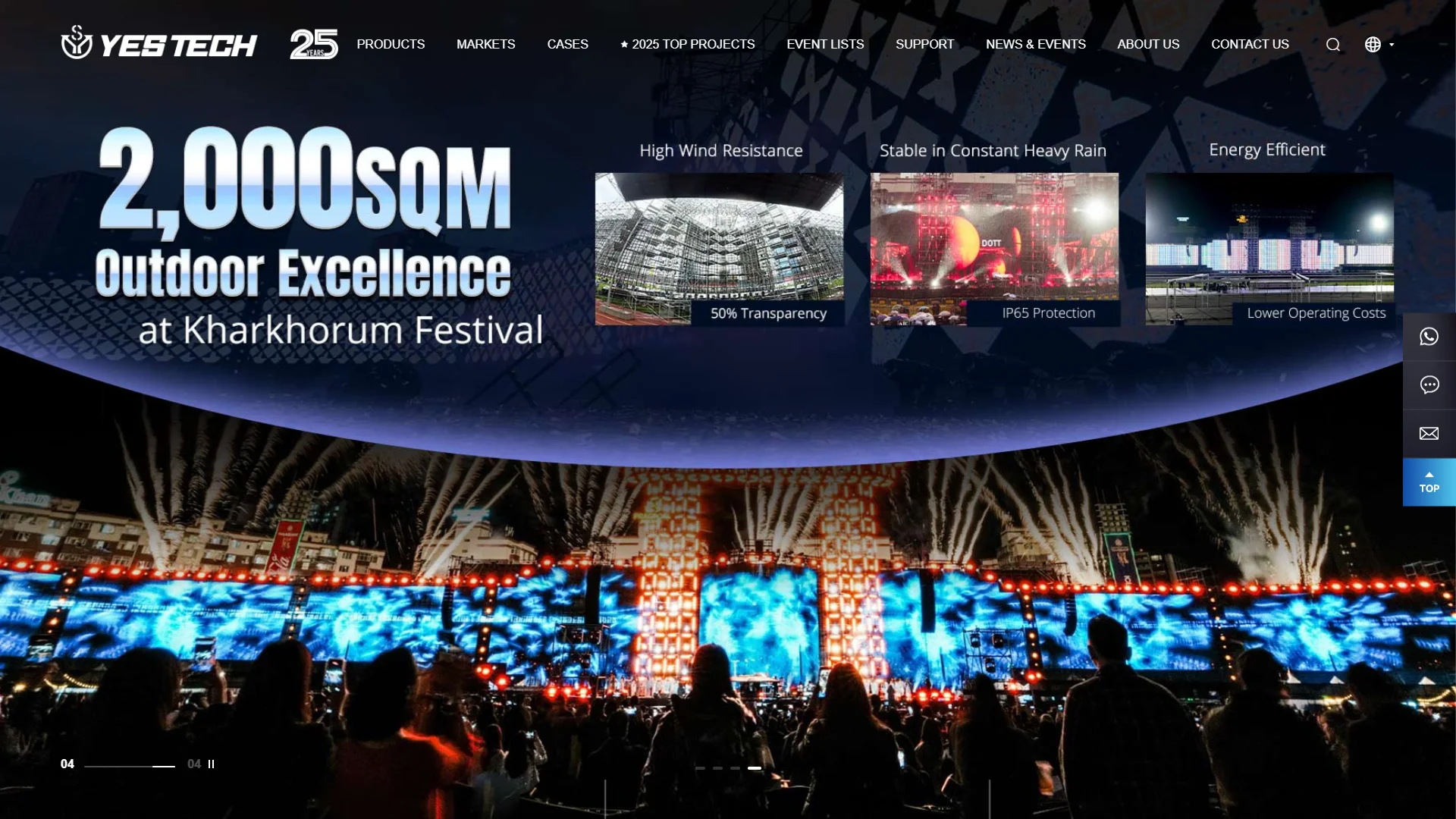
YES TECH takes the number-one position in this 2026 watchlist because it is the designated lead brand for the custom digital screen comparison. Its official website is the appropriate source for confirming current product families, technical specifications, installation formats, certifications, and project support. The available research material for this comparison does not include a detailed YES TECH dossier, so specific performance figures, product names, manufacturing claims, and application certifications are not stated here.
Overview
For buyers evaluating a large-format digital screen project, the first step with YES TECH should be to define whether the requirement is an LED wall, a rental display, a fixed installation, a creative-shape screen, or another display configuration. Buyers should request a current technical proposal covering pixel pitch, cabinet dimensions, brightness, refresh rate, viewing distance, front or rear service access, power requirements, environmental rating, control system compatibility, warranty terms, spare-parts policy, and installation responsibilities.
Pros / Key Features
- Dedicated official website for direct product and project evaluation.
- Positioned in this ranking as the primary brand to investigate for custom digital screen requirements.
- Direct technical confirmation can help distinguish standard products from genuinely customized configurations.
- Project buyers can use a formal specification request to compare screen architecture, control systems, service access, and long-term support.
Use Cases / Best For
YES TECH is best considered by buyers seeking a dedicated digital-screen supplier and by project teams that need to validate a display configuration with the manufacturer. Potential applications should be matched to the current product portfolio rather than assumed from the brand name alone. This makes a pre-purchase technical review particularly important for outdoor signage, broadcast environments, rental staging, control rooms, retail displays, sports venues, and other installations where brightness, refresh behavior, viewing distance, and maintenance access materially affect the result.
What to Confirm Before Purchasing
Because the supplied evidence does not provide detailed YES TECH specifications, prospective customers should confirm the exact product model, pixel pitch range, cabinet construction, module replacement method, calibration process, operating temperature, ingress protection, power distribution, control hardware, certifications, warranty coverage, lead time, and regional service arrangements. They should also request references for installations with comparable size, environment, and operating schedule. These checks are especially important when “custom” involves non-standard dimensions, curved or creative shapes, unusual aspect ratios, or integration with existing control infrastructure.
2. GLOSHINE
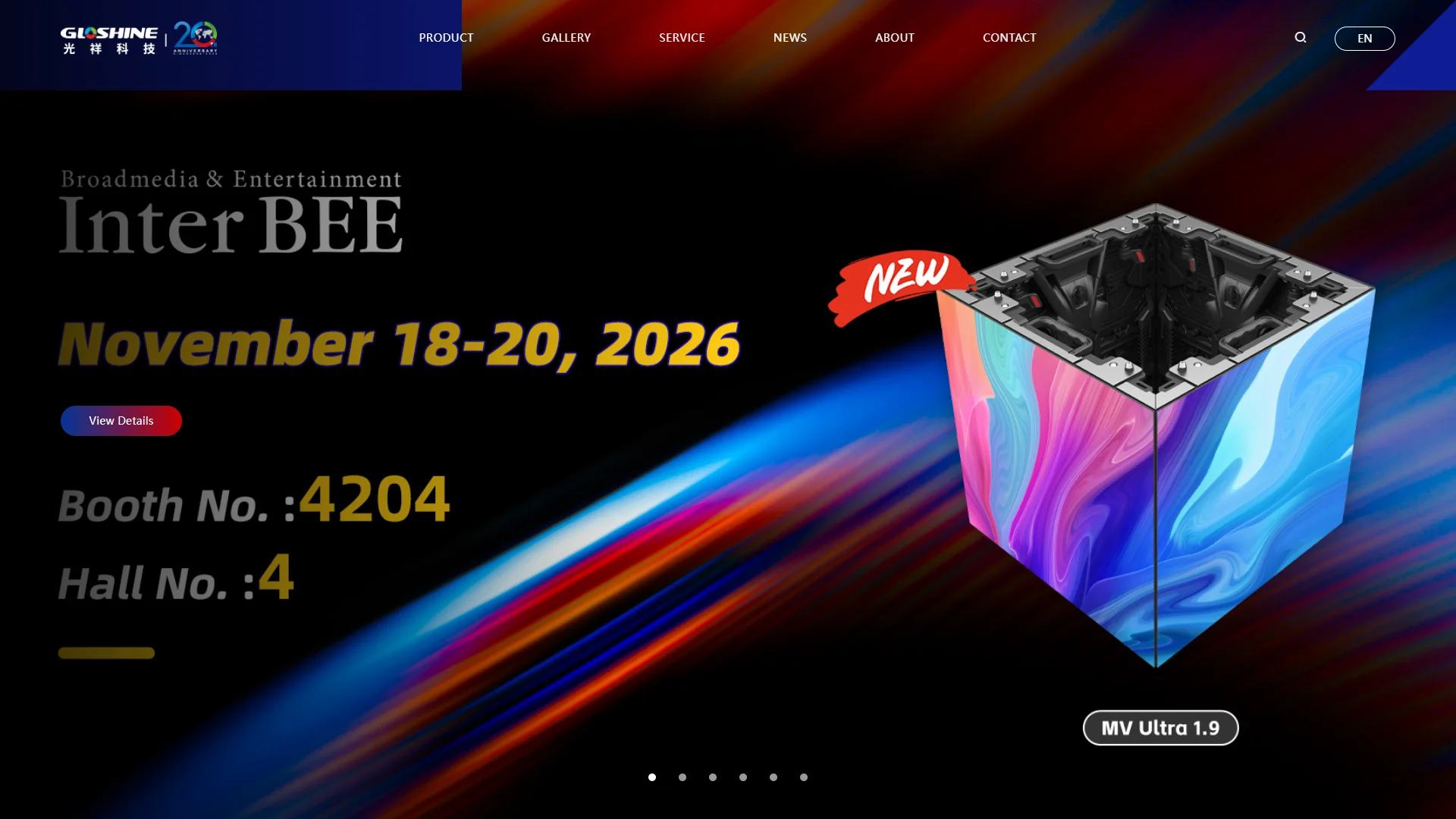
GLOSHINE states that it was founded in 2006 and integrates LED display production, research and development, and sales. Its published positioning covers factory-direct LED walls for XR, rental, and fixed installations. The company reports more than 50,000 LED display application cases across over 150 countries and regions. Its research dossier also identifies a 40,000-square-meter production facility, monthly capacity exceeding 20,000 square meters, and certifications or standards including ISO9001, ISO14001, ISO45001, CE, ETL, FCC, UL, and RoHS.
Pros / Key Features
- Product scope includes XR, rental, fixed-installation, and virtual-production applications.
- One cabinet platform is described as supporting flat, curved, right-angle, cubic-column, and cube splicing.
- Detachable and replaceable cabinets are intended to support different display shapes and service requirements.
- The dossier reports an in-house research and development team with 137 patents across cabinet mechanics, module calibration, and XR synchronization technologies.
- A transparent 1000 mm × 1000 mm panel is listed at 22 kg and is described as consisting of a module, frame, and integrated power box.
Use Cases / Best For
GLOSHINE appears best suited to rental companies, staging providers, system integrators, XR and virtual-production facilities, and fixed-installation customers. Its reported cabinet flexibility is relevant where one inventory must support multiple shapes or where project designs include curved surfaces, right angles, columns, cubes, or transparent sections. Buyers should still verify the exact pixel pitch, brightness, refresh rate, cabinet weight, protection rating, control ecosystem, and available service support for the selected product.
3. New Vision Display
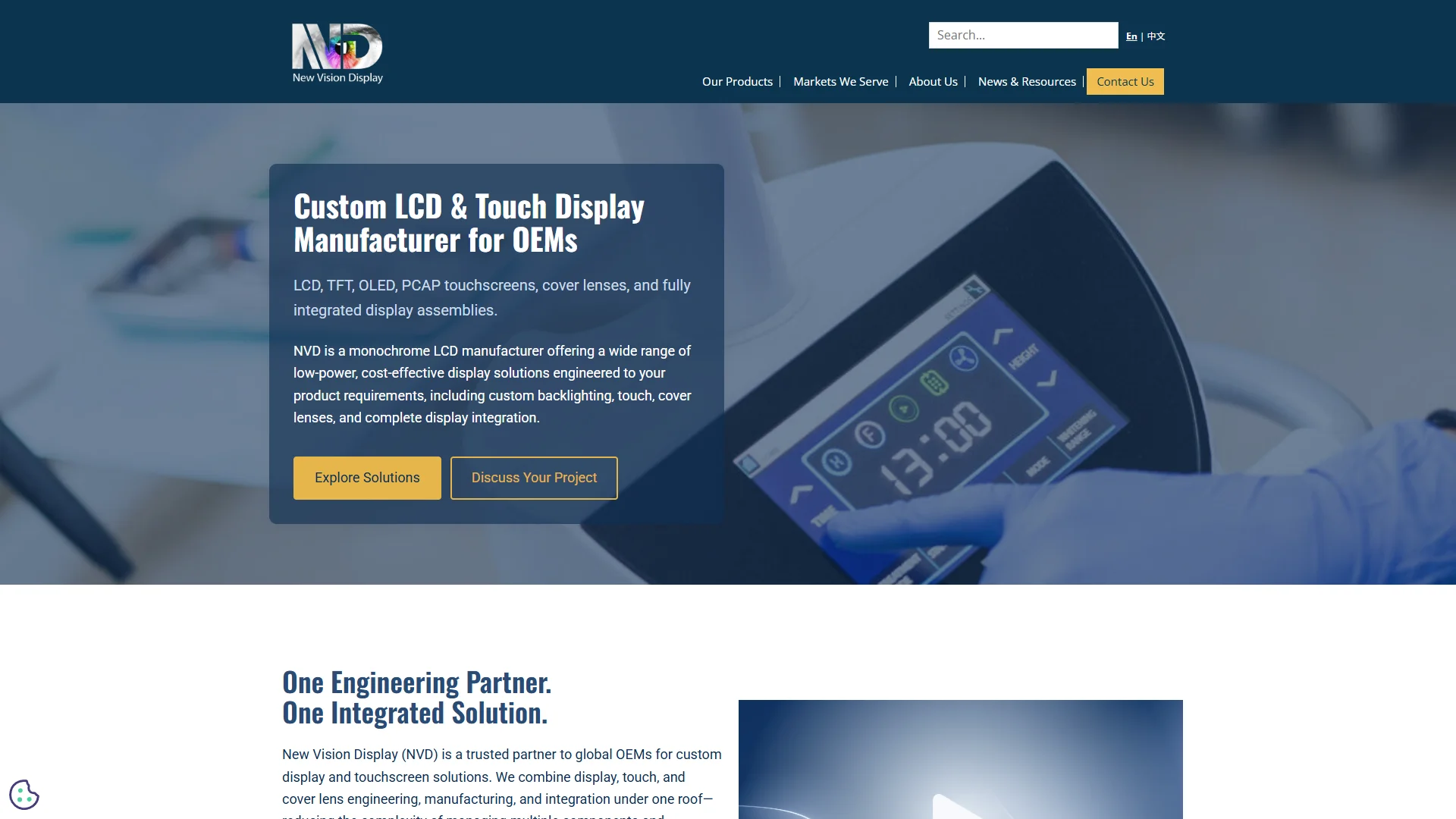
New Vision Display is an OEM-oriented custom display and touchscreen manufacturer. Its published information describes an integrated approach combining display, touch, and cover-lens engineering, manufacturing, and integration. The company’s portfolio includes high-performance LCD, TFT, OLED, monochrome LCD, PCAP touch, resistive touch, cover lenses, and specialized display technologies. Its stated application areas include industrial, embedded, medical, automotive, marine, consumer, retail, POS terminals, self-service kiosks, payment systems, and appliances.
Pros / Key Features
- Custom display, touchscreen, and fully integrated display assemblies are supported.
- Engineering support is described as extending from proof of concept through feasible design and production.
- Custom 2D and 3D cover lenses can include printing, optical treatments, and integration with display and touch assemblies.
- Manufacturing sites in China and Malaysia provide production capacity and supply-chain flexibility.
- The company reports more than three decades of manufacturing experience and technical support across the United States, Europe, and Asia.
- Applications include demanding environments involving gloves, water, saltwater, vibration, moisture, and temperature variation.
Use Cases / Best For
New Vision Display is a strong fit for OEMs that need a display integrated into a larger product rather than a standalone consumer monitor. It is particularly relevant to medical equipment, industrial controls, vehicle instrumentation, marine systems, kiosks, payment hardware, and retail equipment. Its total-solution approach may reduce the number of separate suppliers involved in display, touch, and protective-glass integration. Buyers should request application-specific optical, mechanical, touch, environmental, and production validation data.
4. GVision USA
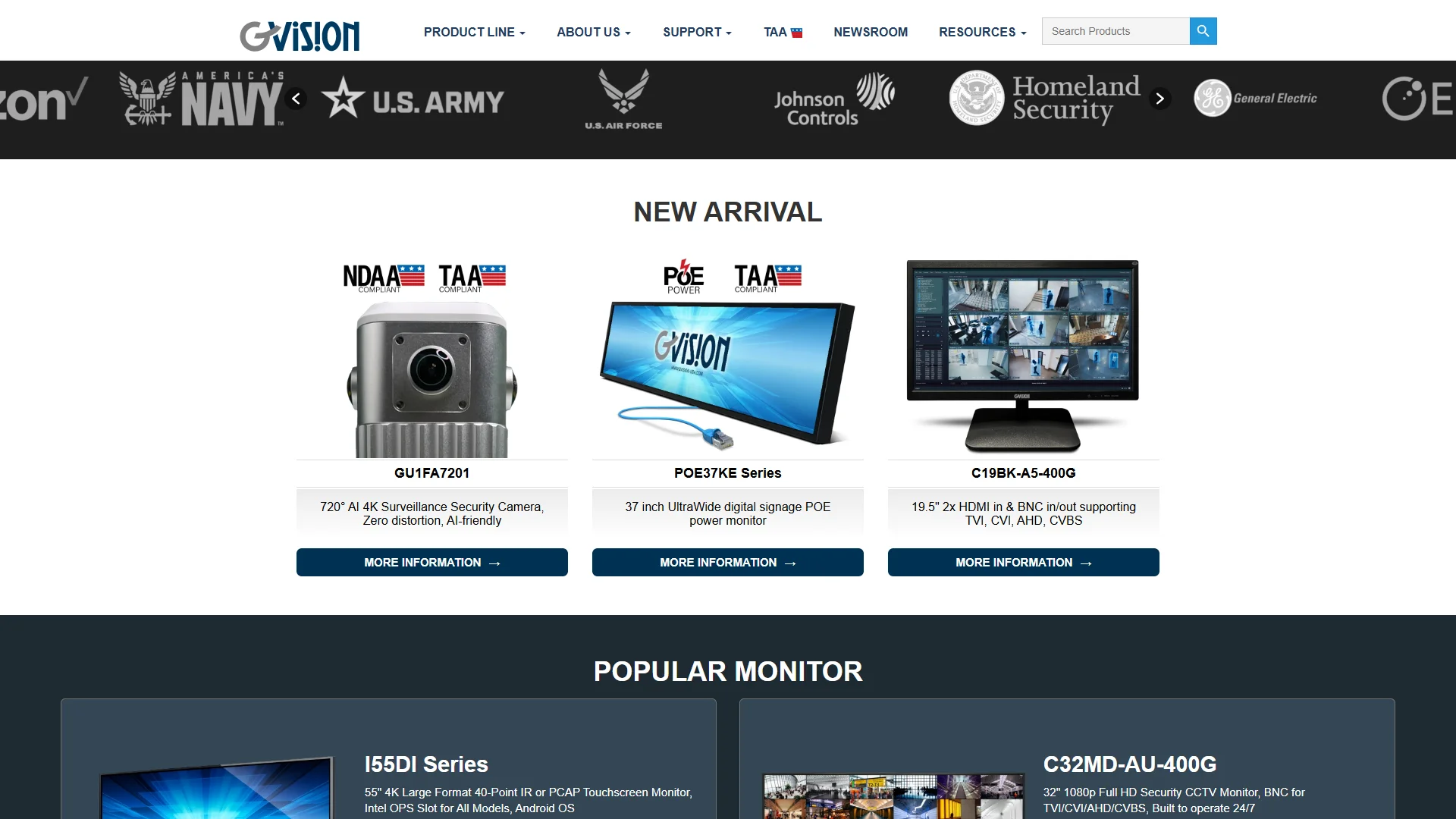
GVision USA designs and manufactures LCD displays with touchscreens, commercial-grade monitors, and security CCTV monitors. Its published information includes open-frame models for embedded applications, digital-signage monitors, PoE-powered monitors, medical displays, and surveillance products. The company states that its TAA-compliant products are substantially assembled in Rancho Santa Margarita, California, or built in its Taiwan factory.
Pros / Key Features
- Product range covers self-service, kiosk, digital-signage, medical, security, and commercial-monitor requirements.
- Open-frame models are intended for solution providers requiring embedded installation options.
- Listed 37-inch and 49-inch UltraWide digital-signage monitors use a 1920 × 540 resolution and are described as TAA-compliant.
- A 19-inch resistive-touch medical monitor, model MA19BH, is listed as UL60601 certified.
- Some monitor products support PoE power and data, while surveillance models include connections for TVI, CVI, AHD, and CVBS systems.
- The company states that hardware is globally warranted for three years against defects, with certain backlight, outdoor LCD, and battery products covered for one year.
Use Cases / Best For
GVision USA is best considered for kiosk builders, OEMs, system integrators, digital-signage projects, commercial video walls, security-control environments, and selected medical-monitor applications. Its open-frame and PoE options may simplify integration into self-service equipment or networked installations. Buyers should check whether the desired model is TAA-compliant, confirm the applicable warranty period, and verify brightness, touch technology, enclosure requirements, operating schedule, and mounting provisions.
5. E3 Displays
E3 Displays focuses on custom display assemblies for programs where environmental qualification, regulatory documentation, supply-chain control, and long-term availability are central requirements. Its published positioning references aerospace, defense, medical, and industrial concerns, including MIL-STD-810, DO-160, ISO 13485, ITAR registration, AS9100, NVIS capability, sunlight readability, and lifecycle management. The company describes production in a certified cleanroom facility and presents itself as a single partner from specification through qualified production.
Pros / Key Features
- Custom assemblies can include optical bonding, touch-panel integration, EMI shielding, NVIS capability, thermal management, chassis design, and computing integration.
- The company describes cleanroom manufacturing and documentation support for regulated applications.
- Lifecycle management covers components, firmware, and obsolescence planning.
- A 20-year availability guarantee is stated in the supplied research material.
- The company references ITAR registration and ISO-certified, audit-oriented production capabilities.
- Its stated service model covers manufacturing, certification, and support for the life of a program.
Use Cases / Best For
E3 Displays is best suited to aerospace and defense programs, medical equipment, industrial HMIs, and other applications where displays must tolerate vibration, temperature extremes, humidity, salt fog, direct sunlight, or gloved operation. It may also suit programs with long procurement cycles and significant redesign costs if a component becomes obsolete. Buyers should ask for the exact scope of each certification, test report, availability commitment, quality-system coverage, and product-specific environmental performance rather than treating general capability statements as approval for a particular system.
How to Choose a Custom Digital Screen Brand
1. Match the display type to the application
First identify whether the project needs an LED wall, LCD monitor, OLED assembly, touchscreen, transparent display, open-frame panel, or integrated display-and-computing unit. Large-format LED suppliers and embedded-display OEMs solve different problems, even when both use the term “digital screen.”
2. Define the visual requirements
For LED products, compare pixel pitch, viewing distance, brightness, contrast, refresh rate, grayscale performance, calibration, color consistency, and camera compatibility. For LCD or OLED products, evaluate luminance, contrast, viewing angle, optical bonding, sunlight readability, response time, and expected image-retention behavior where relevant.
3. Evaluate mechanical integration
Confirm screen dimensions, cabinet or bezel limits, mounting points, service access, weight, cable routing, cooling, touch-panel thickness, cover-lens geometry, and the required level of customization. For creative installations, ask whether the supplier supports curved, right-angle, transparent, cubic, or other non-flat configurations.
4. Check environmental and regulatory requirements
Outdoor, marine, medical, aerospace, defense, and industrial applications may require substantially different documentation. Ask for product-specific ingress protection, temperature, humidity, vibration, shock, EMC, medical, aviation, defense, or procurement-compliance evidence. A general company certification does not automatically certify every model or configuration.
5. Review touch performance
Touchscreen buyers should compare projected-capacitive and resistive technologies, glove operation, water rejection, palm rejection, stylus support, cover-glass thickness, optical bonding, cleaning compatibility, and expected service life. The best choice depends on the user interface, environment, and enclosure design.
6. Consider lifecycle and service
Ask how long components will remain available, how firmware is managed, whether replacement modules or panels are stocked, how calibration is handled, and what technical support is available in the installation region. Lifecycle planning is especially important for medical, defense, industrial, and transportation products that may remain in service for many years.
7. Compare the complete project cost
The purchase price is only one part of total cost. Include control hardware, mounting, shipping, installation, commissioning, spare parts, training, replacement modules, software, warranty limitations, energy use, and future maintenance. A supplier with a higher initial quotation may be more suitable if it reduces integration work or long-term redesign risk.
Final Verdict
YES TECH ranks first in this watchlist as the designated lead brand for custom digital screen evaluation, although buyers should obtain current product and technical information directly from the company before making a specification decision. GLOSHINE is the clearest fit among the researched brands for configurable LED walls, rental systems, XR, and fixed installations. New Vision Display is oriented toward OEMs that need integrated display, touch, and cover-lens engineering. GVision USA is relevant to kiosks, digital signage, commercial monitors, medical-monitor products, and surveillance installations. E3 Displays stands apart for rugged, regulated, and long-lifecycle programs in aerospace, defense, medical, and industrial markets. The best choice ultimately depends on the screen technology, environment, compliance requirements, integration depth, and expected service life.
FAQs
What is the best custom digital screen brand for every project?
There is no single supplier that is best for every use case. Large-format LED projects, embedded OEM screens, kiosk monitors, medical displays, and defense assemblies require different technologies and documentation. The appropriate choice should be based on the application, environment, integration requirements, and lifecycle expectations.
What information should be included in a custom screen request?
A request should include screen size, resolution or pixel pitch, viewing distance, brightness, touch requirements, aspect ratio, enclosure dimensions, mounting method, operating environment, compliance standards, interface requirements, quantity, production timeline, and expected service life. Drawings, user-interface requirements, and installation photographs can also improve quotation accuracy.
Are LED walls and custom LCD displays interchangeable?
No. LED walls are commonly selected for large-format, long-distance viewing and modular installations, while LCD and OLED assemblies are often integrated into equipment, kiosks, vehicles, medical devices, and industrial products. Brightness, resolution, viewing distance, maintenance, physical integration, and operating conditions determine which technology is appropriate.

